Addressing Food Insecurity and Poverty Through Conditional Cash Transfers in the Lao People’s Democratic Republic

A confluence of challenges, including food insecurity, poor nutrition, gender inequality, and climate change, drives fragility and poverty in the Lao People’s Democratic Republic (Lao PDR). At the same time, significant debt distress, accompanied by slower economic growth since the COVID-19 pandemic, has placed strain on the government’s fiscal capacity to fund programs to address these challenges.
ADB’s Building Resilience and Reducing Rural Poverty Project, approved in October 2024, has an ambitious target to enroll at least 25,000 new poor and vulnerable households into the government’s nutrition-sensitive conditional cash transfer (CCT) program in provinces and districts with high rates of poverty, malnutrition, and climate and disaster risks. To complement the expansion in CCT coverage, the project will help introduce the first poverty graduation program specifically for rural women, helping them diversify incomes and access sustainable livelihoods. It will also digitize social protection systems and make them more adaptive and shock-responsive.
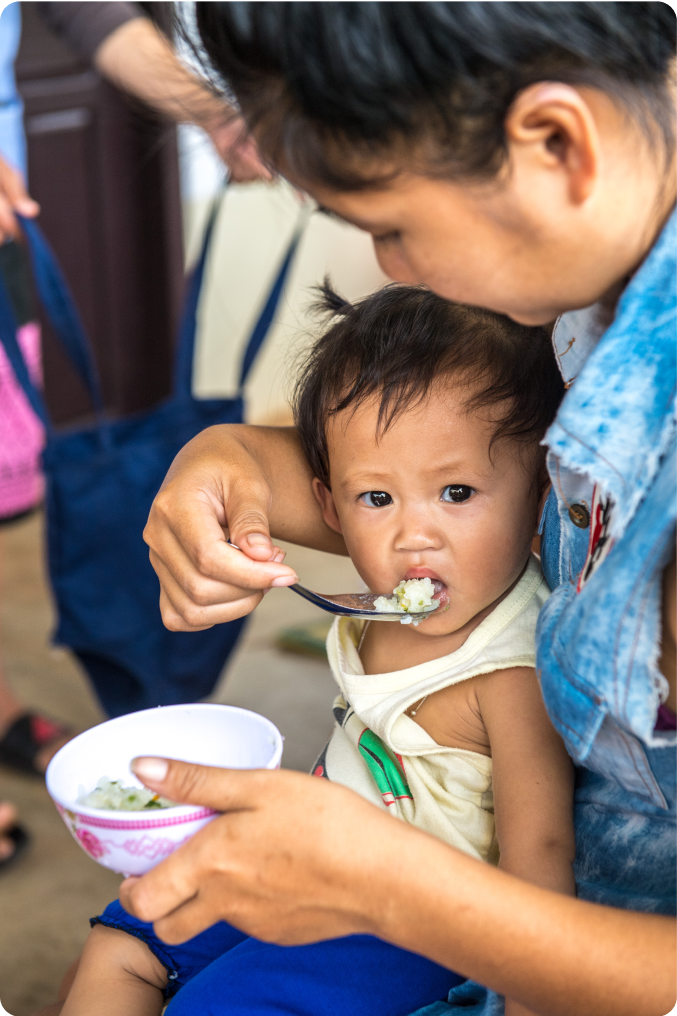
The CCT program targets poor pregnant women and mothers of children under 2, recognizing the importance of adequate nutrition during the first 1,000 days of a child’s life. Beneficiaries receive grants of about $12 per month, conditional on attending antenatal care visits, participating in monthly village health and nutrition social and behavior change communication sessions, and taking children 0–2 years old for regular growth monitoring and immunization. The World Bank and ADB have collaborated closely in expanding the government’s CCT program into provinces and districts where there are significant gaps in social protection coverage for the most vulnerable people.
CCT programs have proven to be an effective way to reduce poverty and food insecurity; empower women; and build resilience in poor rural communities. The poverty graduation program will deliver a holistic set of sequenced and time-bound interventions on top of the cash transfers, including livelihood grants for sustainable income generation, technical skills training, and psychosocial support. Meanwhile, investments in digital social protection and monitoring and evaluation will strengthen the government’s capacity to efficiently implement priority programs, respond to shocks, and track both progress and vulnerabilities at a more granular level.
The project features strong alignment with three of the five strategic focus areas of ADB’s Strategy 2030 midterm review:
- (i)
climate action, by improving social protection system’s links to climate and disaster risk information,
- (ii)
digital transformation, by digitizing management of CCT beneficiary enrollments and payments, and
- (iii)
resilience and empowerment, through multiple components to support the project’s impact (social welfare system strengthened to build resilience and promote human and social development) and outcome (food security, women’s empowerment, and climate resilience among poor and vulnerable households improved).
Principles of Tailored Approaches Exemplified: Building Resilience
and Reducing Rural Poverty Project in the Lao People’s Democratic Republic
Be context-specific. Directly responds to challenges in the Lao PDR’s social protection system, including inadequate coverage of targeted and shock-responsive programs, weak delivery systems and capacity, and limited use of data and evidence to deliver cost-effective programs.
Pursue risk-informed solutions. Provision of targeted and shock-responsive social assistance mitigates the risk of poor and vulnerable households adopting negative coping behaviors such as skipping meals, selling assets, and spending savings during crises.
Ensure broad and enduring engagement. Poverty graduation program involves key stakeholders such as the Lao Women’s Union and includes behavior change sessions with participants to improve dietary diversity, hygiene, financial and digital literacy, and women’s agency.
Develop capacity. Targets project management and operational capacity building of the Ministry of Agriculture and Forestry, as the executing agency, in critical functions such as procurement, financial management, safeguards, and implementation of the CCT program.
Adapt and respond to challenging or changing situations. CCT program includes a mechanism to respond to disasters triggered by natural hazards and other shocks, whereby CCT funds may be front-loaded to existing or new households affected by the shock.
Read More Our
Project Stories