Introduction



A.Background
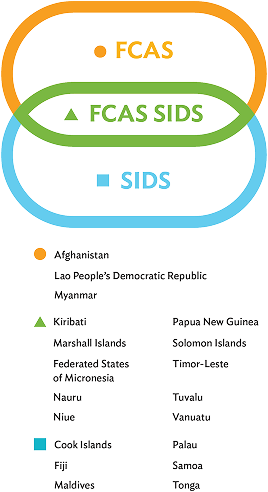
This report reviews the operations of the Asian Development Bank (ADB) in developing member countries (DMCs) classified as fragile and conflict-affected situations (FCAS) and small island developing states (SIDS) in 2024. As of the end of 2024, ADB classifies 13 DMCs as FCAS while 16 DMCs self-identify as SIDS (Figure 1 ).1
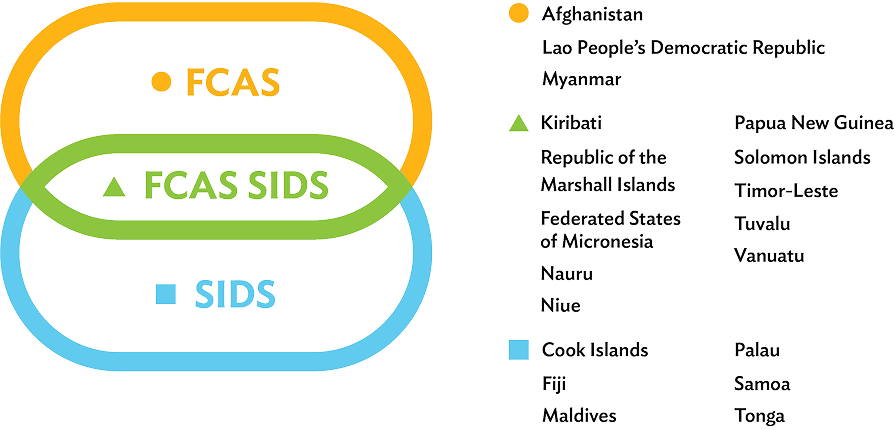
Under Strategy 2030, ADB committed to applying a differentiated approach in FCAS and SIDS, and subnational pockets of poverty and fragility.2 The Fragile and Conflict-Affected Situations and Small Island Developing States Approach (FSA), approved in 2021, operationalized this commitment. Strategy 2030 also required ADB to produce an FSA annual report as ADB’s primary mechanism for reporting on its operations in FCAS-classified DMCs and SIDS.3
This report complements the three flagship corporate performance reports of ADB: the Development Effectiveness Review, which remains ADB’s primary tool for monitoring and reporting on its performance in relation to its corporate results framework; the Annual Portfolio Performance Report, which details the state of ADB's sovereign and nonsovereign portfolios; and the Annual Evaluation Review summarizing the results of independent evaluations.
The Fragility and Engagement Division (CCFE) of the Climate Change and Sustainable Development Department (CCSD) prepares the FSA annual reports. CCFE also coordinates and monitors FSA implementation and the work to mainstream differentiated approaches for FCAS and SIDS across ADB. As the FSA is an ADB-wide approach, CCFE works closely with relevant departments in monitoring and reporting on FSA implementation.
This 2024 FSA Annual Report is the fourth and penultimate FSA annual report covering the original implementation period of the FSA and its Action Plan, 2021–2025.4 However, the FSA midterm review, published in 2024, noted that the FSA remains relevant as an institutional approach and recommended that it be continued through 2030, with a new implementation plan developed for 2026–2030.5 Therefore, ADB will continue to produce the FSA annual report, aligned with the new FSA Implementation Plan, through 2030.
CCFE is developing the new FSA implementation plan, 2026–2030, building off the existing action plan for 2021–2025 and additional guidance in the FSA midterm review, which proposed areas of emphasis to address gaps in the implementation of the FSA and improve its effectiveness.6
The review and evolution of the FSA supports ADB’s broader strategic agenda with its new operating model (NOM) adopted in 2023 and the midterm review of Strategy 2030 in 2024. The Strategy 2030 review resulted in a new Corporate Results Framework, 2025–2030 and the introduction of five strategic focus areas, including 12 development result indicators linked to the Sustainable Development Goals.7 By 2026, all ADB operations must align with the strategic focus areas and these indicators to ensure harmony between operations and corporate priorities.
Of particular importance for FCAS and SIDS is the resilience and empowerment strategic focus area, as this contains a specific tracking indicator on ADB financing for FCAS and SIDS as part of ADB’s corporate results framework. This indicator stipulates that 7.5% of ADB’s total nonsovereign and sovereign financing should be committed in FCAS and SIDS by 2030. In addition, “FCAS and SIDS” is included as a sub-area under the resilience and empowerment strategic focus area.
B.Building Resilience
amid Rising Fragility
Since ADB approved the FSA in 2021, fragility has been on the rise in Asia and the Pacific, exacerbated by global shocks and economic headwinds.8 The trend of rising fragility spans FCAS-classified DMCs and SIDS as well as DMCs outside the FCAS and SIDS framework.
The FSA 2023 Annual Report explored this trend. Among its findings were that rising fragility has driven up the perception of risk in ADB’s most vulnerable DMCs, severely restricting private investment, hamstringing government service delivery, and jeopardizing the success of ADB and development partner interventions. 9
Amid a backdrop of rising global and regional fragility, building resilience in FCAS and SIDS is crucial for lowering risk and risk perception levels and ensuring that ADB’s development interventions have their desired outcomes. According to the FSA midterm review, “FCAS-classified DMCs’ and SIDS’ elevated vulnerability to the climate crisis and their weak resilience require renewed emphasis on steering development decisions in resilient directions.” It recommends that CCFE work with the climate change thematic group to ensure that country partnerships, projects, and programs have a strong focus on building long-term resilience through climate adaptation and disaster risk management (footnote 5).
The FSA midterm review also recognized that building resilience should extend beyond the structural and environmental dimension to the other three dimensions of risk and resilience that ADB considers in fragile
contexts—political and societal, institutional, and economic.
Furthermore, ADB’s approach to building resilience in FCAS and SIDS must be holistic and transformational, considering not only the tangible human and economic impacts of fragility, but also less tangible impacts such as heightened gender inequality or loss of biodiversity, cultural heritage, or indigenous knowledge.
One way ADB supports resilience in FCAS and SIDS is through fragility and resilience assessments (FRAs), which analyze key drivers of fragility and risks across the four intertwined dimensions and recommend solutions for vulnerable DMCs to manage these fragilities and risks. ADB conducted several FRAs at both the country and project levels in 2024, while also launching watching briefs and a country risk monitor to ensure that ADB is better prepared to support DMCs when external or internal crises emerge, and that DMCs are better prepared to manage such crises.
A growing focus area of ADB’s work in FCAS and SIDS is private sector development. The private sector can play a key role in resilience-building in fragile contexts — for instance by lowering poverty levels, creating jobs, or developing solutions to mitigate disaster risk. The Strategy 2030 midterm review identified private sector development as one of the five strategic focus areas, while the FSA midterm review identified strengthened private sector development and investment as an area of emphasis, noting that private sector investment levels in FCAS-classified DMCs and SIDS have been decreasing.
Both reviews noted gaps in ADB’s approach to attracting capital to higher-risk environments such as FCAS and SIDS. The 2026–2030 FSA implementation plan will articulate new approaches for supporting private sector development and increasing private sector investment in FCAS and SIDS.
The FSA 2023 Annual Report highlighted the main challenges dragging down the performance of FCAS and SIDS projects and recommended solutions to these challenges (footnote 9). 10 Some changes under the NOM—for instance, stronger decentralization of staff and more focused CCFE focal point support to ADB country and project teams in FCAS-classified DMCs and SIDS—are helping to address the challenges.
Although it will take more time for these solutions to drive improved results in ADB’s FCAS and SIDS portfolio, some improvements are already being realized. Even as overall results of completed operations in FCAS and SIDS continued to lag bank-wide results in 2024, several metrics show progress. ADB commitments in FCAS and SIDS continued to grow in 2024, while several FCAS-classified DMCs and SIDS registered robust success rates of completed operations (75%–100%) when looking at a longer period, 2016–2024. Furthermore, if one groups projects by approval year (versus completion year), there is notable improvement of success rates in more recently approved projects in FCAS and SIDS, pointing to better results in the years ahead.
With the NOM largely implemented, the strategic focus areas—including resilience and empowerment—become the main corporate pillars driving the evolution of the FSA. This will be reflected in the new FSA implementation plan, which will align closely with the strategic focus areas and their 12 Sustainable Development Goals-linked development result indicators.
Read Our
Project Stories