2024 Activities:
Stepping Up One
ADB Collaboration
and Differentiated
Business Processes



This chapter outlines key highlights of ADB’s operational work to implement the FSA in 2024. CCFE coordinates this work, guided by the FSA Action Plan, 2021–2025 and monitored through the FSA action tracker (Appendix 1). This work falls under four key areas:
- (i)
Institutional change. This includes the development and application of analytical tools to monitor the effectiveness of the FSA and ADB’s results in FCAS and SIDS, and the development and application of differentiated business processes.
- (ii)
Strategic operations support. This workstream fosters cooperation among departments and divisions to mainstream ADB’s differentiated approach in FCAS and SIDS, including through CPSs, investment projects, and TA.
- (iii)
Knowledge and analytics. This covers staff and client training, partnerships, digital and other analytical tools, and knowledge products and resources such as articles and reports on special topics and awareness-raising materials. Analyzing portfolio results using visualization tools and dashboards is another component of this work.
- (iv)
Communications and events. These comprise outreach, engagement with stakeholders, and dissemination of knowledge products and services via the ADB website, FCAS and SIDS community site, FCAS and SIDS Bulletin, webinars, and more.
For a thorough accounting of all FSA activities in 2024 against the FSA Action Plan, 2021–2025, broken down by pillar, key action area, and sub-action, refer to Appendix 1.
A.Institutional Change:
Supporting Differentiated
Processes to
Improve Results
In 2024, teams across ADB continued to apply updated business processes introduced in 2023 under the new operating model (NOM). During two installments of the Introduction to Differentiated Approaches training course organized by CCFE, ADB staff from different departments came together to highlight what these updated business processes mean for project teams and offer participants a chance to apply them and gain a deeper appreciation of their flexibilities through case studies.
Differentiated approaches documentation. A key achievement in 2024 was the compilation of differentiated approaches from across ADB. Staff had raised questions about how ADB works differently in FCAS and SIDS contexts, and a new resource, in the form of a presentation available on the internal FCAS and SIDS community site, provides further clarity. The presentation explains what a differentiated approach is and why ADB applies them. The analysis then digs into areas where ADB differentiates its work in FCAS and SIDS, starting with how it resources its work, looking at ADF 14 as the principal resource. The presentation then looks at special instruments and innovative approaches for financing, such as ADB’s new concessional lending terms for SIDS, novel financing arrangements, and contingent disaster financing.
The next section of the presentation on differentiated approaches examines organizational and staffing resources. For example, the FCAS and SIDS team under CCFE is ADB’s only team dedicated to supporting a specific group of DMCs. The section notes that partnerships are of elevated importance in FCAS and SIDS contexts, such as with United Nations agencies and CSOs in
conflict-affected situations. Next, the presentation analyzes differentiated approaches in ADB’s business processes and templates, many of which were updated to support the NOM. To support these changes, ADB has multiple handbooks and guidance notes that assist project teams in understanding and applying the flexibilities allowed within ADB’s standard business processes. The presentation also considers differentiated approaches to capacity development in FCAS-classified DMCs and SIDS, as well as knowledge and analytics focused exclusively on FCAS and SIDS, such as fragility and resilience assessments (FRAs) and watching briefs.
Analyzing low success ratings in FCAS and SIDS. CCFE initiated a study on factors contributing to the low success ratings of operations in FCAS and SIDS to further staff understanding of the importance of applying differentiated approaches. The study’s premise is the lagging performance of completed projects in FCAS and SIDS contexts. Although there have been instances of improvement, the general trend of the FCAS-SIDS portfolio is of declining performance. The ongoing study summarizes common factors identified in project validation reports as contributing to low success ratings in FCAS and SIDS. CCFE will share the findings of the study with country teams and their respective portfolio management units.
One finding is that infrastructure projects in FCAS and SIDS contexts underperform those in non-FCAS SIDS DMCs—only 42% of completed infrastructure projects in FCAS-classified DMCs and SIDS were rated successful during 2016–2023, compared with 72% in non-FCAS/SIDS. Artificial intelligence (AI)–assisted analysis of more than 30 features and 4,000 data points from the FCAS-SIDS dataset showed correlations among some groups and project outcomes. Common issues with project implementation, according to the qualitative analysis, include
- (i)
a lack of thorough assessment of government capacity,
- (ii)
changing government priorities,
- (iii)
land acquisition delays, and
- (iv)
challenges with procurement.
The study is a powerful tool to understand changes that could boost development results in FCAS-classified DMCs and SIDS. CCFE has shared the study’s findings with project teams, at multiple outreach events, and in staff training.
Country performance assessments. Under the guidance of ADB’s Strategy, Policy, and Partnerships Department, CCFE provided a light-touch review of all draft country performance assessments (CPAs) for FCAS-classified DMCs and SIDS in 2024. CPAs—along with World Bank Country Performance and Institutional Assessments—form the basis for ADB’s existing FCAS classification exercise. As such, the team considered consistency across assessments and ensured reviews captured the sources of fragility and resilience for these countries. Based on the final scores, CCFE conducted the 2024 FCAS classification exercise. The outcome included an improved score for Palau, thus moving it off ADB’s list of FCAS-classified DMCs. However, Niue’s and Vanuatu’s average CPA and Country Performance and Institutional Assessment scores were below the 3.2 threshold, warranting their classification as FCAS.
In 2025, ADB is revisiting its FCAS classification exercise and considering other options for how it groups countries facing multiple drivers of fragility and vulnerability and/or conflict. ADB’s 2022 Annual Evaluation Report on FCAS and SIDS urged ADB to move away from a binary grouping of countries and develop an approach that better suits ADB’s portfolio. 32
Handbook series. CCFE expanded its series of internal handbooks to support ADB teams working in FCAS and/or SIDS contexts in key strategic and operational areas. After publishing guidance on preparing an FRA and a project administration manual in 2023, CCFE published a handbook for preparing a risk assessment and risk management plan (RAMP) in FCAS and SIDS in 2024. The RAMP is mandatory for most ADB sovereign loan and grant projects and is prepared as a supplementary document to the report and recommendation of the President.
The RAMP handbook offers project team leaders guidance in identifying, measuring, and mitigating multidimensional risks in FCAS and SIDS, and compiling those risks into a comprehensive risk matrix, organized around the four dimensions of risk and resilience and aligning with the five principles of tailored approaches in FCAS and SIDS. 33 It features a discussion of ADB’s differentiated risk appetite for certain types of risks in FCAS and SIDS, and an annex listing dozens of resources that project officers may find useful in preparing the RAMP. In addition, ADB revised the RAMP template to include a note flagging the new handbook to team leaders working on reports and recommendations of the President in fragile contexts.
Tailoring the Climate Change Action Plan to SIDS. The Pacific Department (PARD) launched an initiative in 2024 to recommend ways to tailor ADB’s Climate Change Action Plan, 2023–2030 to the Pacific context, by mapping ADB’s differentiated approaches to enhance climate change outcomes. In collaboration with PARD and CCSD’s Climate Change, Resilience, and Environment Cluster, CCFE identified Pacific-specific needs, such as those of atoll nations, and developed tailored actions to ensure more effective delivery of ADB’s Climate Change Action Plan in the Pacific.
FSA implementation plan. CCFE is leading preparation of the FSA Implementation Plan, 2026–2030, which will build on and replace the FSA Action Plan, 2021–2025. The new plan will reflect the new challenges ADB faces in supporting its FCAS-classified DMCs and SIDS to achieve key development objectives such as building resilience to climate change and expanding private sector investment.
FCAS classification system. As part of the new implementation plan, ADB is reviewing its FCAS classification system with a view toward revising and updating this system. ADB intends to shift from a binary list of countries that are FCAS-classified to an approach that recognizes the nuances of fragility and resilience.
Handbook series. Given the prevalence of capacity constraints in ADB’s FCAS-classified DMCs and SIDS, CCFE will expand its handbook series to include guidance on strengthening the capacity of ADB staff to integrate capacity building of executing and implementing agencies to deliver ADB-financed projects. The handbook will examine capacity development across individual, organizational, and institutional levels. In conjunction with the handbook, CCFE will revise its capacity assessment and support plan template developed in 2022.
B.Strategic Operations
Support: Addressing
Vulnerability, Fragility,
and Resilience
Fragility and resilience assessments. ADB continued to strengthen the methodology and approach for conducting country-level FRAs that inform preparation of CPSs. In 2024, FRAs contributed to CPS processes for Bangladesh, Maldives, and PNG; and an FRA was prepared for Timor-Leste following the 2023 national elections. Abbreviated country-level FCAS assessment diagnostics were prepared twice during 2024 for Sri Lanka, reflecting rapidly evolving situations around the 2024 national elections.
Anticipating preparation of its new Pacific Approach strategic framework for 2026–2030, ADB also initiated, in 2024, FRAs for Pacific DMCs Nauru, Tuvalu, and Vanuatu. ADB prepared FRAs for projects in Bangladesh and Myanmar where the complexity, prevailing risk factors, and scale of operations warranted in-depth analysis of vulnerability, fragility, and resilience. It continues to use the findings of FRAs for capacity development of project officers working across DMCs experiencing vulnerability and/or fragility, and CCFE is developing a series of country profile documents, in coordination with resident missions and Pacific country offices.
Support for Pacific Approach. Throughout 2024, CCFE participated in early-stage meetings for preparation of the Pacific Approach, 2026–2030, and will continue to support the ongoing development of the plan in 2025. The Pacific Approach covers the 12 smallest Pacific DMCs in lieu of CPS for these countries.34
Watching briefs. In situations of crisis or transition there is often a need for enhanced situational country-level political-economic monitoring. CCFE has developed a watching brief facility that supports regional departments and resident missions in better understanding the context in which they work. Examples of this facility include
- (i)
periodic reporting of the impact of the conflict in Gaza on Asia and the Pacific;
- (ii)
providing data via an internal country risk monitor for monthly watching briefs in the run-up to the 2024 presidential and parliamentary elections in Sri Lanka; and
- (iii)
sustained analytical support to the Bangladesh Resident Mission and South Asia Department through preparation of weekly watching briefs in the 6 months following the 2024 political crisis in Bangladesh and the change of government, driven by popular protest.
These concise documents covered a range of political economy issues relevant to Bangladesh’s political transition and ADB operations.
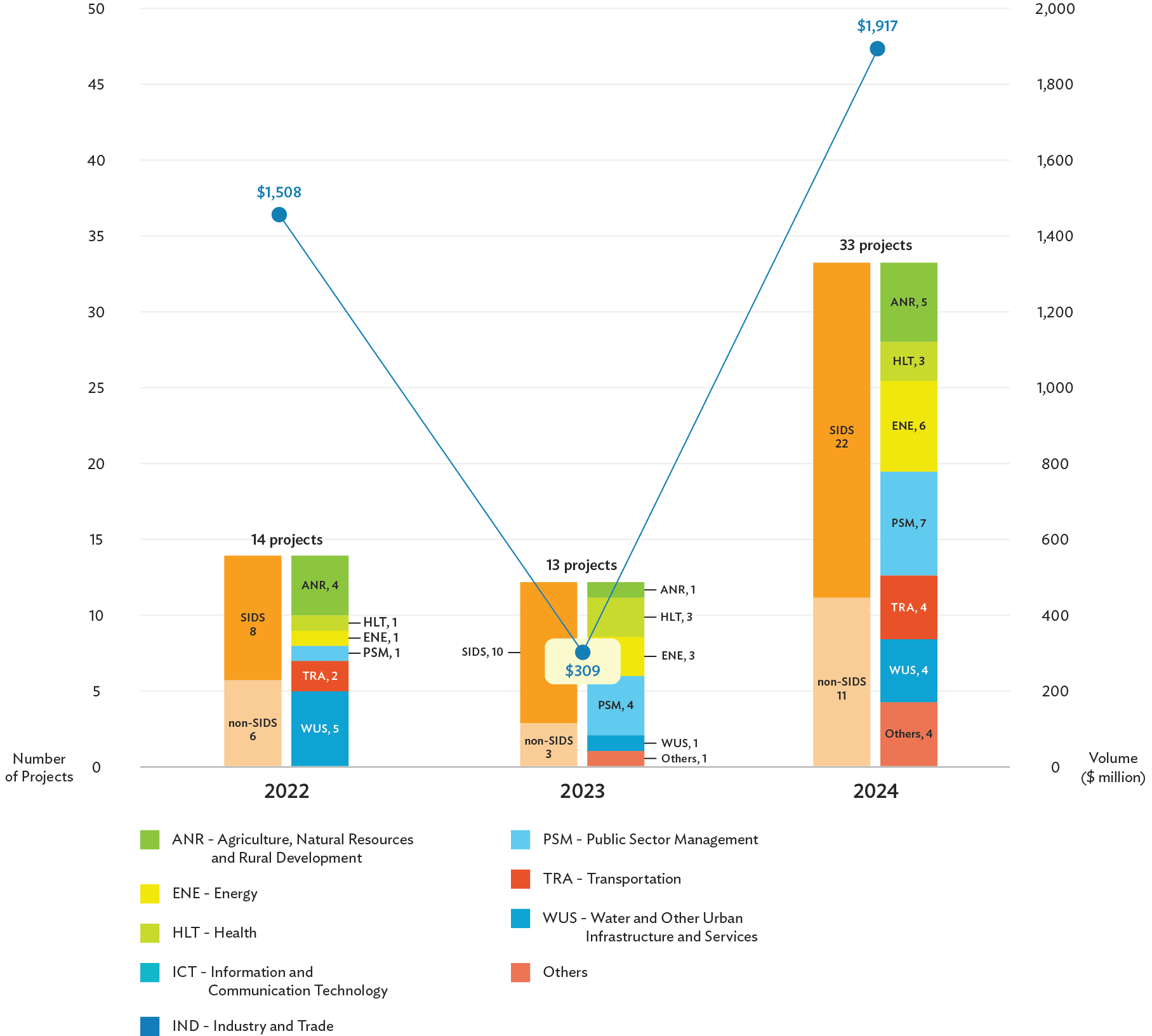
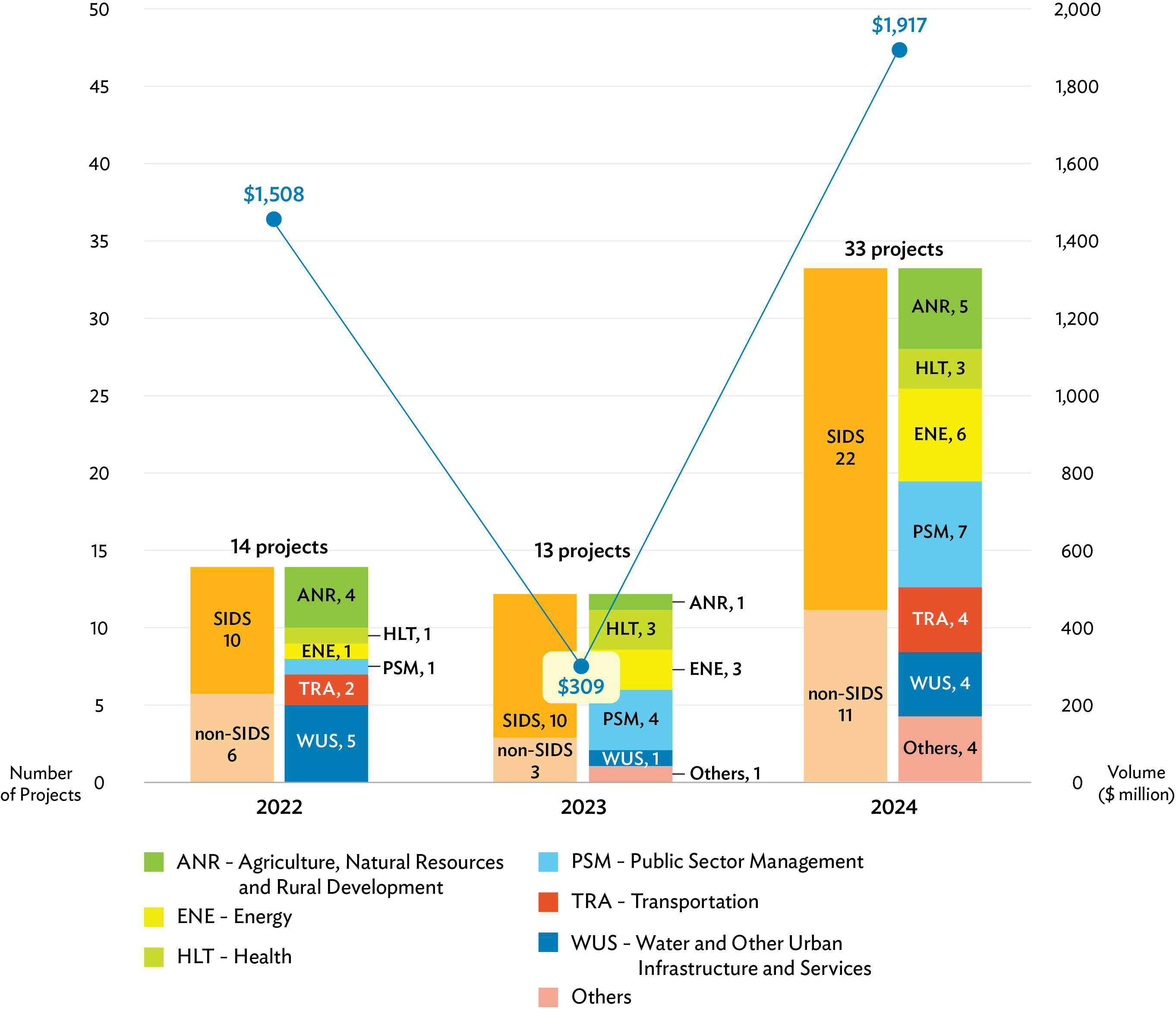
Technical support from CCFE to operations. CCFE provided guidance and input to sector departments and regional departments as collaborative “One ADB” team members for sovereign project process and documentation development for 27 investment projects (15 initiated in 2024, and 12 continuing from pre-2024) and 6 TA projects (three initiated in 2024 and three continuing from earlier approval) (Figure 19). Project modalities included 15 grants, 6 concessional and OCR-financed loans, and 6 mixed grant and loan investments. Of the 18 projects approved in 2024, 15 were for SIDS, indicating the chronic vulnerability and fragility in these challenging environments. The sector distribution among the 2024 approvals reflected the need to tackle weak governance and the lack of essential infrastructure. The public sector management sector accounted for five projects; the transport sector four projects; the energy sector three projects; and the ANR, health, and WUS sectors two projects each. CCFE was further assigned as supporting thematic department in 2024 for six projects across five DMCs experiencing vulnerability and/or fragility.
Figure 19: Fragility
and Engagement Division Advisory Support to
ADB Projects
- 1.
Advisory support from CCFE pertains to participation of an FCAS and SIDS unit focal person in consultation meetings, missions, or project-level fragility and resilience assessments.
- 2.
Volume in $ (blue line) is indicative as final amounts are only determined at project approval.
- 3.
Volume in 2022 was significant as it included advisory support for the Afghanistan Sustaining Essential Services Delivery Project and initial planning for the Afghanistan Expanding Essential Food Security and Health Services Project.
Country risk monitor. In support of CCFE’s increasing technical input to ADB operations and a growing range of diagnostic and analytical work, CCFE and the ADB Corporate Services Department initiated the design phase of a country risk monitor in 2024. The country risk monitor will track evolving risks across a range of indicators in DMCs and serve as a potential early warning system for emerging economic, financial, political, social, and other crises. Its data warehouse will help inform ADB’s identification system for countries experiencing fragility (under review and update as of 2025); as well as contribute to analysis and diagnostic tools, including watching briefs on specific countries or subjects to inform ADB Management, FRAs, and other risk-related assessments. The country risk monitor has flexibility for collaboration with additional ADB departments (e.g., the Office of Risk Management).
Outreach in Sri Lanka. In February and August 2024, CCFE supported the South Asia Department in conducting outreach and engagement activities with civil society and political parties in anticipation of the presidential and parliamentary elections in Sri Lanka in the second half of 2024. CCFE and the Sri Lanka Resident Mission also developed and delivered a prototype internal country risk monitor and six associated monthly watching briefs to monitor the situation in the country from June to December 2024. The monitor and monthly watching briefs informed the positioning of ADB operations to support a critical program of economic reforms following Sri Lanka’s sovereign default and political crisis in mid-2022.
FRAs. ADB is preparing country-level FRAs for the Cook Islands, the Federated States of Micronesia, Niue, and Solomon Islands and is contributing to the new Pacific Approach, 2026–2030. ADB is also preparing an FCAS assessment for Thailand. CCFE continues to coordinate with regional departments and resident missions on FRAs and watching brief preparation in response to emerging situations during 2025. It will provide concise updates for FRAs developed during 2023–2024.
Support for ADB teams and projects. CCFE continues to serve as One ADB team members in support of sector departments and resident missions in operations design, processing, implementation, and evaluation. It is simultaneously building the awareness and capacity of sector departments’ staff active in developing member countries experiencing vulnerability and fragility.
Country risk monitor. CCFE will complete development of and operationalize the country risk monitor. It continues to seek opportunities to collaborate across ADB regional and sector departments to maximize use and application of country risk monitor data.
C.Knowledge and
Analytics: Leveraging
Data, Partnerships,
and Training to Support Contextualized Responses
Background studies. CCFE commissioned a series of studies throughout 2024 and 2025 to feed into fragility diagnostics, knowledge, and operations. Topics of completed studies included mapping conflict and fragility in Asia and the Pacific, stocktaking of ADB’s policy and projects on peace and development (2004–2024), analyzing factors contributing to the low success ratings of completed operations in FCAS and SIDS, and understanding challenges and opportunities for women entrepreneurs in SIDS. Studies on the following were begun in 2024, to be completed in 2025:
- (i)
capacity development in SIDS,
- (ii)
data on solutions to forced displacement.
Data and analytical tools. CCFE updated its FCAS and SIDS portfolio database and data visualization tool (DataViz) quarterly throughout 2024. The portfolio data were useful in analyzing trends and understanding performance across five indicators: contract award, disbursement, output, safeguards, and financial management. Launched in 2023, DataViz continues to serve as a valuable reference in FRA preparation. It provides trendlines and other information on the FCAS and SIDS portfolio through charts and graphs. The Pacific Urban Resilience Measurement Index was developed for use by DMCs and tested in the capitals of Vanuatu and Solomon Islands to support monitoring of urban resilience in the Pacific.
Peer learning network. The peer learning network was first established in 2022 to bring together staff working in and/or having an interest in FCAS and SIDS. The 2024 gatherings focused on understanding digital technology and cybersecurity risks, organized together with CCSD’s Digital Technology for Development Division; sharing practical project engagement strategies and approaches in FCAS and SIDS (featuring five staff from ADB headquarters and resident missions); and discussing differentiated approaches ADB uses to better address the needs of FCAS and SIDS, featuring a study by the Climate Change, Resilience, and Environment Cluster identifying opportunities to scale up differentiated approaches in the Pacific.
Staff training. CCFE led two installments of its 2-day Introduction to Differentiated Approaches training program in 2024. It introduced a simplified, case-study-based format for the program, allocating more time for fewer but deeper discussions over 2 days. Presentations were made by relevant ADB teams covering cross-thematic areas including financing modalities, financial management, procurement, risk management, gender, CSO engagement, and safeguards. Attendees were taught to apply differentiated business processes (e.g., procurement, RAMP) to theoretical case studies in FCAS and SIDS, employing the five principles of tailored approaches (footnote 33) where relevant. Group discussions facilitated peer learning and exchange. A separate training on Leadership in FCAS and SIDS was held for senior staff and Management with the objective of enhancing skills for effective engagement in FCAS and SIDS, including sessions on driving innovation, boosting effective collaboration, and examining fragility dynamics through case studies and discussions.
Collaboration with other ADB departments. Together with ADB’s Corporate Services Department, CCFE developed an issue brief on staff safety and security risk considerations alongside a template that could be used by resident missions to prepare staff for country missions from a security perspective. It also teamed up with PARD to write a policy brief in the August 2024 Pacific Economic Monitor on “Understanding Vulnerability, Fragility, and Resilience in Pacific Small Island Developing States.”
Partnerships and knowledge exchange. ADB worked with several international organizations and agencies to exchange knowledge and support for multilateral development bank (MDB) coordination such as through the MDB Coordination Platform on Economic Migration and Forced Displacement, and the United Nations Peacebuilding Architecture Review.
Through regular meetings of the World Bank-led Working Group on Fragility, Conflict, and Violence, CCFE continued its engagement with peer MDBs, such as the African Development Bank, European Bank for Reconstruction and Development, European Investment Bank, Inter-American Development Bank, International Fund for Agricultural Development, and Islamic Development Bank. These meetings covered topics such as strategic approaches to fragility, advancing gender engagement and addressing gender inequalities, and climate finance. Attendance by MDB representatives increased significantly from almost 40 in April to more than 55 in October.
Knowledge products. CCFE is continuing to expand ADB’s understanding on topics related to vulnerability, fragility, and resilience and expect to release internal and external publications covering capacity development in SIDS, a background study on data on solutions to forced displacement, and a study on informal settlements in the Pacific. Country-specific pieces will include a climate and security assessment for PNG, and an “after action” review of the economic crisis in Sri Lanka.
Knowledge exchanges on key thematic issues. ADB is serving as the senior chair of the MDB Platform on Economic Migration and Forced Displacement for the first half of 2025. ADB also continues to serve on the advisory group for the Internal Displacement Monitoring Center. ADB continues to dialogue with international organizations and partners on key topics including climate change, forced displacement, peacebuilding and conflict prevention, and building resilience in DMCs through better understanding of vulnerability and fragility.
Training for ADB staff. CCFE continues to improve upon the Introduction to Differentiated Approaches in FCAS and SIDS training series, and will also hold a focused training program on capacity development in FCAS and SIDS.
DMC knowledge resources. CCFE is working with appropriate sector and thematic departments to collate a knowledge library to capture ADB’s differentiated approaches to addressing vulnerability, fragility, and resilience, and continues to apply innovative e-learning approaches for DMCs.
D.Communications and Events: Broadening Institutional Awareness of the FCAS and SIDS Approach
A multimedia approach. CCFE has created videos, scripts, frequently asked questions (FAQs), and microsites to accompany and/or highlight several written knowledge products, e.g., CCFE’s internally published handbooks on ADB processes and publications, such as the FRA and project administration manual handbooks. The thought process is that by offering knowledge products in multiple formats, CCFE will improve the reception and comprehension of these products among relevant staff. In addition, CCFE has worked to ensure sustained and lasting impact of the videos, scripts, FAQs, and microsites by creating bite-sized information products such as blurbs and FAQ slides to share and repost across internal channels such as the peer-learning network, the One ADB Today daily mailer, and the FCAS and SIDS community site and quarterly email bulletin. These products were later reposted during relevant events or activities.
Dissemination of knowledge products. The team disseminated several knowledge products in 2024, both internally and publicly. Although the FSA midterm review (footnote 5) is a classified internal document, a public summary version was created and published on the ADB website. Other website updates included a new visualization of the FCAS classification list.
A whiteboard animation video titled Understanding Fragility in Asia and the Pacific explains the four dimensions (six in SIDS) of risk and resilience that are considered by ADB in fragile contexts. The video is based on ADB’s 2023 publication A Conceptual Understanding of Fragility in Asia and the Pacific, which provides a framework for ADB to assess the root causes of fragility and identify sources of resilience in designing programs and projects and undertaking FRAs and other analytical work. The video focuses on defining the language ADB uses when discussing fragility.
Ensuring accessibility to information. CCFE regularly maintained and updated the FCAS and SIDS community site, including the FCAS and SIDS toolkit, throughout 2024. Additions to the site included two CCFE handbooks on differentiated business processes, content from three training events, a glossary of FCAS and SIDS terminology, and a new navigation bar. The FCAS and SIDS community site received more visits than any other ADB community site that tracks visitor numbers.
Regional dialogues. These sessions will foster dialogue among ADB staff and stakeholders in FCAS and SIDS about vulnerability, fragility, and resilience in the Pacific islands. Attendees will include a wide range of stakeholders from the region.
ADB and Fragility Knowledge-Sharing Series. The ADB and Fragility Webinar Series was renamed the ADB and Fragility Knowledge-Sharing Series to reflect the trend of in-person and hybrid events. This series continues to host discussions on operations in FCAS and SIDS and knowledge products.
Continued management of communication platforms. CCFE continues to maintain a mailing list (the FCAS and SIDS Bulletin), landing page on the ADB corporate website, and internal FCAS and SIDS community site. It will curate the AI “fragility and engagement” module in ADB Genie, an AI tool being developed by the ADB Information Technology Department for the benefit of Staff.
Read Our
Project Stories